


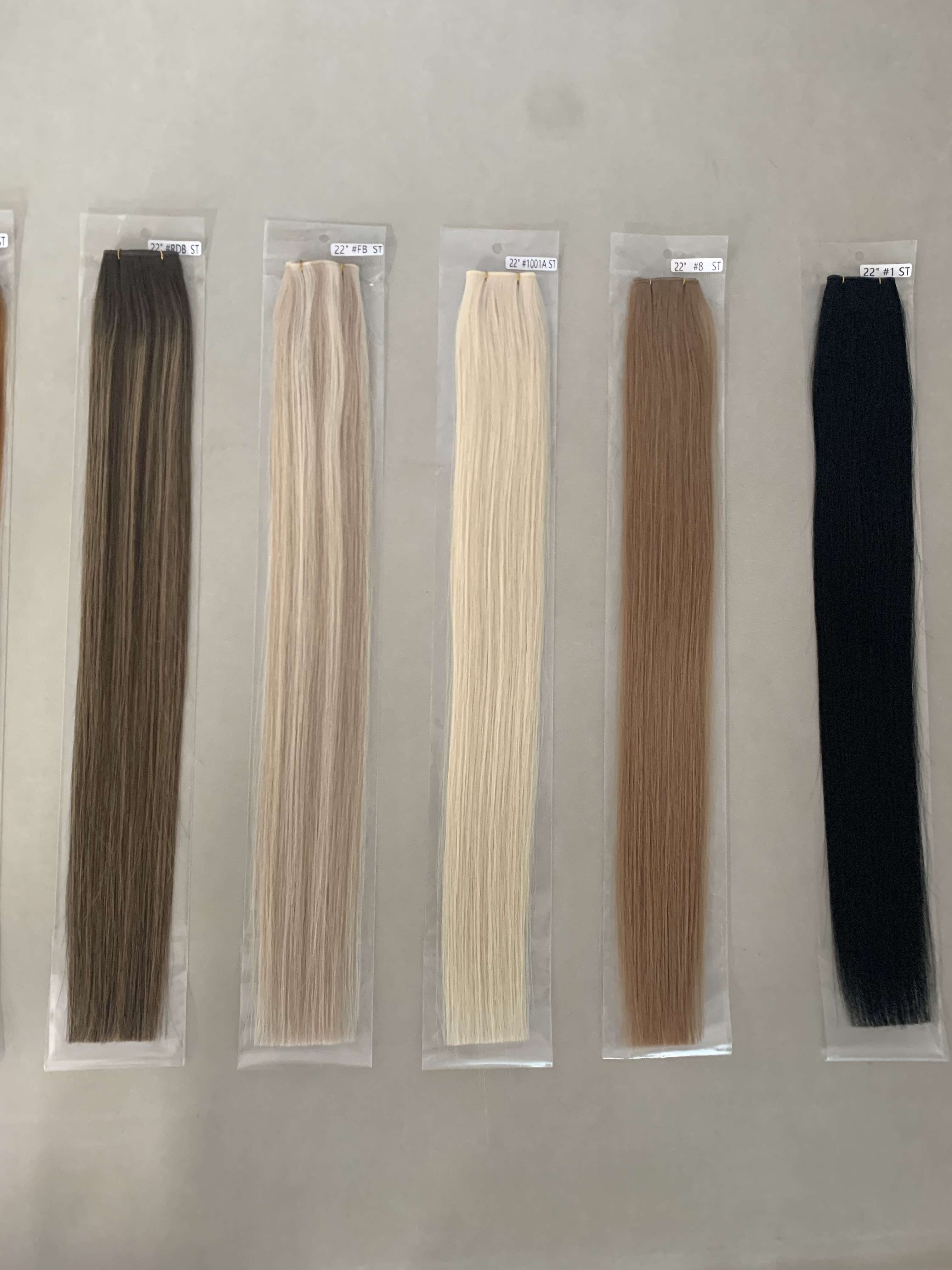
Do you like DIY Clips hair? So let our dolas dream crafts Co.,Ltd teach you how to make clips in hair just by genius weft hair extensions.It is so happy to do this
Transforming your premium Genius Weft into custom clip-in extensions is a cost-effective way to offer your clients versatile, temporary volume. Because the Genius Weft is designed to be cut without unraveling and lies flat against the head, it creates a seamless, invisible base that is far superior to traditional bulky wefts .
Here is a step-by-step guide to manufacturing clip-ins from your weft hair.
Step 1: Gather Your Materials
Before starting, ensure you have the following tools on hand :
· Genius Weft Hair: 1–2 bundles (depending on desired thickness).
· Silicone-Grip Clips: Metal clips with a silicone strip inside for a secure, non-slip hold .
· Needle and Thread: Use a strong thread that matches the weft color.
· Sharp Scissors: For cutting the weft and trimming thread.
· Measuring Tape: To measure sections of your head.
· PU Strip or Fabric Glue (Optional): For reinforcing the cut edges.
· Thinning Shears (Optional): For texturizing the ends.
Step 2: Measure and Cut the Weft
A standard set of clip-ins usually consists of 5–7 pieces of varying widths to fit the curve of the head .
1. Measure the Placement: Use a measuring tape to determine the width needed for different areas: the nape of the neck (approx. 4" / 13 cm), the back of the head (ear-to-ear, approx. 9" / 23 cm), and the sides (approx. 4" each) .
2. Cut the Weft: Using sharp scissors, cut your Genius Weft according to these measurements. Since the Genius Weft is specifically designed to be cuttable, you will not experience excessive shedding along the raw edges .
· Pro Tip: For a standard set, you can cut one 4-clip weft, two 3-clip wefts, and two 2-clip wefts .
Step 3: Seal the Edges (Optional but Recommended)
While the Genius Weft is engineered to minimize shedding, sealing the edges adds durability for extensions that will be clipped in and out frequently.
· Method A (Sewing): Run a quick line of tight, overcast stitches along the newly cut edge to lock in the threads .
· Method B (Adhesive): Apply a thin line of fabric glue or clear nail polish along the top edge to seal it .
Step 4: Attach the Clips
This is the most critical step for security. You have two options for attachment:
· Sewing (Recommended for durability):
1. Position the Clip: Place the clip on the top edge of the weft (the side that will face the scalp). Ensure the teeth of the clip face downward and the "snap" mechanism is on top.
2. Sew it On: Use a double-threaded needle. Start by sewing through the first hole of the clip 5–10 times, wrapping the thread around the bridge for extra strength. Move to the next hole and repeat. Finish with a tight knot .
· Gluing (Quick method):
· Apply a strong adhesive or hot glue to the base of the clip and press it firmly onto the weft. Note: Sewing is generally preferred as glue can degrade over time .
Step 5: Customize for a Seamless Blend
To ensure the final product looks natural (especially for Caucasian hair types, which can be finer), perform these finishing touches :
1. Thin the Ends: Use thinning shears to lightly trim the very ends of the weft. This removes the "blunt" cut look and helps the extensions feather naturally into the client's own hair .
2. Layer the Set: Remember that shorter wefts should be placed higher on the head (sides/crown), while the longest weft goes at the nape to create a natural gradient .
The table below compiles the manufacturer's published capabilities and product specifications. ...
READ FULLDolas dream Genius Weft vs. Other Extension Methods Based on verified industry standards, genius wefts ...
READ FULLFeature Dolas Dream (Single Donor) Typical Multi-Donor Remy Cuticle alignment 100% intact, one d...
READ FULL