


The global hair extensions market hit $4.41 billion in 2026, and it's climbing at 6.6% annually . That growth isn't accidental. It's driven by clients who want transformation without waiting years for their natural hair to grow.
But here's the problem for salon owners and retailers. Stocking the wrong extension types not only blocks the cash flow but also frustrates stylists. The result is that inventory keeps sitting, gathering dust. The choice isn't simply about what's popular on Instagram this month. It's about matching the right product to the right client scenario.
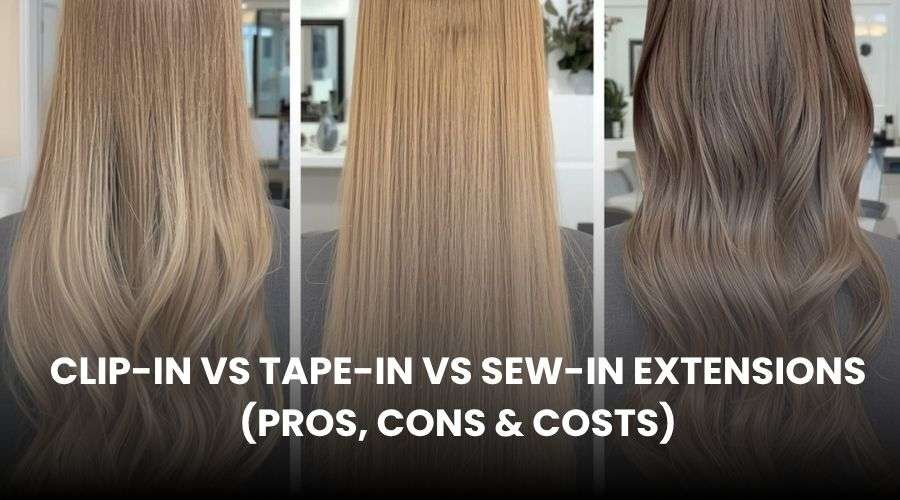
This blog gives an in-depth breakdown of the pros and cons of clip-in, tape-in, and sew-in extensions. With the actual costs, labor requirements, and client retention math, it determines whether a product line builds your business or drains it.
Here's where many buyers miscalculate. They look at the product cost per unit and stop there. But extensions generate revenue in two ways: product sales and service appointments. The right metric isn't what you pay for inventory. It's what your client pays over twelve months.
Product cost to salon or retailer: $50 to $300 per set wholesale, depending on quality and length .
Service revenue: Zero.
That's the trade-off. Clip-ins are pure retail. You sell the set, and the client walks out. You may never see them again for extensions.
But there is a strong demand for this hair extension type as they offer the perfect solution for first-time buyers that want to experiment with hair extensions but are hesitant. If they love the experience and the quality, they may graduate to semi-permanent methods and become your highest-value clients. Stocking clip-ins is about acquiring customers and not retaining old customers.
The variety of choices of clip-ins is another aspect to keep in mind. Each color, length, and weight combination requires separate inventory. And colors go in and out of fashion quickly. The smart decision is to limit clip-in shades to your top five sellers. Let special orders handle the rest.
For beginners comparing materials, this Real vs. Synthetic Hair Extensions guide helps clarify which type delivers the best value and longevity.
Product cost to salon: $200 to $500 wholesale for enough wefts to do a full head.
Service revenue: Installation runs $250 to $600. Then maintenance appointments are every six to eight weeks at $100 to $250 each. Over twelve months, that's five to seven maintenance visits.
In short, one tape-in client can generate $800 to $1,200 in total revenue over a year. Product cost is covered in the first installation. Every maintenance visit after that is mostly labor margin.
The product itself has a limited life. Tape-in wefts can be re-taped and reused two to three times before they need replacement. That means you're selling replacement wefts annually, not monthly- but the service revenue flows consistently.
Product cost to salon: $100 to $300 wholesale for bundles (typically three to four bundles per full head).
Service revenue: Installation runs $200 to $450. Maintenance appointments, tightening the braids, and re-sewing loose wefts run $100 to $200 every six to eight weeks . Removal and reinstallation every two to three months adds another service layer.
The total annual revenue per sew-in client often exceeds tape-ins: $1,000 to $1,800 is realistic. But there's a catch. Sew-ins require the highest skill level. Not every stylist can do them well. And if they're done poorly, the damage to natural hair can be significant.
Not every client is right for every method. For salons buying in bulk, understanding suitability isn't just about better service. It's about reducing returns, complaints, and unsatisfied clients who never come back.
Appeals to First-time Extension Users
Customers can walk in, buy a set, and wear them that night. No appointment and no need for commitment either. This makes clip-ins the perfect hair accessory for first-time extension users who are nervous about adhesive or tension.
Versatile and Universally Applicable
They work on almost everyone. Fine hair. Thick hair. Short hair. Long hair. As long as there's enough natural hair to conceal the weft clips, clip-ins deliver instant volume.
Quick to Install
The liability is minimal. No glue near the scalp. No tension on the roots. No extended wear that traps moisture against the hair. If a client dislikes them, they simply remove them and return the set within your return window.
No Service Revenue
The retail-only model has a ceiling. You sell the product. The client leaves. There's no recurring service revenue attached to clip-ins unless they return for another set.
Only Trending Shades Sell
SKU proliferation is a genuine inventory challenge. Ten shades. Three lengths. Two weights. That's sixty SKUs, each with its own carrying cost and markdown risk. Stock the wrong shades, and cash sits on the shelf for months.
Tough Competition in the Market
Once a customer knows their shade and length, they have little incentive to return to your salon for their next set since these are so widely available.
This is why many salons focus on proper guidance and aftercare, as explained in How to Take Care of Hair Extensions, to build longer-term relationships even with retail-only clients.
Revenue Model
The revenue model is reliable and easy to keep track of. A single tape-in client generates installation revenue, followed by move-up appointments every six to eight weeks. That's five to seven service visits annually, each with product replacement built in. For salons, that is steady service revenue.
User Experience
The user experience is really favorable as they are quite comfortable to wear. Clients sleep in them. Shower in them. During styling, these extensions behave naturally. The wefts lie flat against the scalp, invisible to touch and sight. For clients who want semi-permanent volume with minimal daily effort, tape-ins deliver.
Color Customization
Color customization is straightforward. You stock weft packs in standard shades. Your stylist mixes shades on the client's head to create custom color blends. Fewer SKUs to maintain while still offering the personalized service clients expect.
Adhesive Loses Grip
The adhesive has limits. Clients with very oily scalps may find tape-ins loosen faster than the standard six-to-eight-week cycle. That means more frequent move-ups, which is more revenue, but also more client inconvenience. Managing expectations upfront is essential.
Stylist Needs to Be Skilled
Skill requirements are real. Improper placement causes slippage. Improper removal damages natural hair. Stylists need certified training to install and remove tape-ins safely. This isn't a skill you hand to a junior stylist without supervision.
Limited Shelf Life
The product has a shelf life. Tape-in wefts can be re-taped and reused two to three times before replacement. But each reapplication degrades the adhesive bond and the hair quality. Clients will need new wefts annually.
Durability
Durability is unmatched. Sew-in wefts don't rely on adhesive that degrades or clips that shift. They're sewn directly onto cornrowed natural hair. Clients can wear them for weeks with confidence.
Does Not Affect Existing Hairstyle
Protective styling is a genuine benefit. The natural hair stays braided underneath, reducing manipulation, heat exposure, and breakage. For clients with textured or coily hair, sew-ins offer style versatility while promoting hair health.
Correct Application Means Loyal Clients
Client loyalty runs deep. A quality sew-in installation requires skill and trust. When a client finds a stylist who braids with proper tension and sews with care, switching costs are high. These clients often stay for years.
Time-Consuming Application Session
The installation time is substantial. Two to four hours for a full sew-in. That's a significant block in a stylist's day. Scheduling requires discipline, and cancellations hurt more than with shorter services.
Potential Risk of Hair Loss
Tension risks are real. Cornrows that are too tight cause traction alopecia, permanent hair loss along the hairline and parting lines. This isn't a theoretical risk. It's a liability exposure that requires ongoing training and vigilance.
Not Suitable for Thin Hair
Not every client qualifies. Sew-ins require medium to thick natural hair to create a secure braid base. Fine or thin hair may not hold the tension safely. Turning away clients who aren't candidates is good business, but it means lost revenue in the moment.
If you're still unsure how to evaluate different extension types, this comprehensive guide for choosing the best hair extensions breaks down the key factors to consider before investing in inventory.
There's only the right method for your client base and your business model.
For salons with diverse clientele, stock all three, but manage clip-in inventory conservatively. Limit shades to your top five sellers. Invest more heavily in tape-ins for their recurring revenue potential. Keep sew-in inventory lean but available for clients who need them.
For salons specializing in textured hair, prioritize sew-in bundles. Your clients likely already know this method and expect expertise. Tape-ins may have limited demand in this market. Clip-ins can serve as an entry point for clients new to extensions.
For retailers selling direct to stylists, tape-in weft packs and sew-in bundles offer better inventory turnover than clip-in sets. Stylists restock these regularly. Clip-ins are a one-time purchase per client. Build your inventory strategy accordingly.
Three reasons salon owners choose a single-donor Genius Weft over multi-donor Remy hair. Lifespan: the Genius...
READ FULLHere's a number most stylists never count: the minutes an install swallows before the first strand eve...
READ FULLStock and custom are not quality tiers. Both paths draw on the same raw material and the same producti...
READ FULL