


2026
2026–2034
by 2034
Share
Share
Share
The Beauty Industry's Most Resilient Growth Story
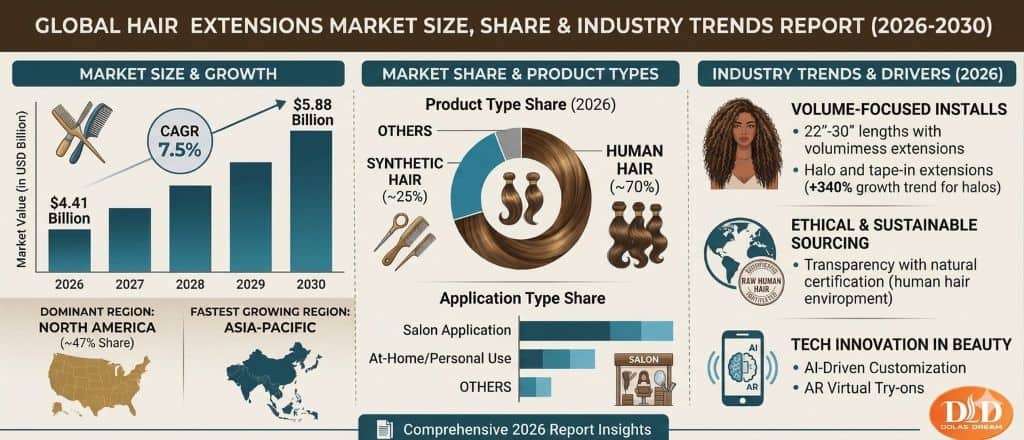
The global hair extensions market is no longer a luxury niche; it is a multi-billion-dollar industry sitting at the intersection of fashion, personal care, and medical wellness. In 2026, the market stands at $4.41 billion and is accelerating toward $5.54–$5.88 billion by 2030–2034, driven by forces that are structural rather than cyclical.
Walk into any salon in New York, Lagos, Mumbai, or Seoul, and the scene tells the same story: clients asking for more volume, more length, more versatility, and getting it through hair extensions. What changed is who is asking. Extensions are no longer exclusive to celebrities or bridal parties. Social media normalization, rising disposable incomes, and the democratization of professional-grade products have brought them into everyday beauty routines across income brackets and geographies.
This report consolidates data from Fortune Business Insights, Grand View Research, Strategic Market Research, Custom Market Insights, Market Research Future, Research and Markets, and several other authoritative sources. It is designed for salon owners, beauty brands, B2B buyers, investors, and e-commerce operators who need accurate, actionable market intelligence, not marketing copy.
Current Market Size & Valuation (2024–2026)
Market valuation depends heavily on research methodology. Here is a side-by-side comparison of what leading research firms report for the hair extension segment:
| Research Source | Base Year Value | Year | Projected Value | Target Year | CAGR |
|---|---|---|---|---|---|
| Fortune Business Insights | $2.87B | 2025 | $5.54B | 2034 | 7.74% |
| Business Research Company | $4.13B | 2025 | $5.88B | 2030 | 7.5% |
| Custom Market Insights | $3.1B | 2026 | $6.3B | 2035 | 8.1% |
| Market Research Future | $3.1B | 2025 | $6.4B | 2035 | 7.5% |
| SkyQuest Technology | $3.75B | 2024 | $6.95B | 2033 | 7.1% |
| Fairfield Market Research | $3.0B | 2026 | $4.8B | 2033 | 7.0% |
| Grand View Research (Wigs+Ext.) | $15.22B | 2025 | $31.13B | 2033 | 9.6% |
| Strategic Market Research | $10.8B | 2024 | $17.4B | 2030 | 8.3% |
Where the Market Stood in 2025
The global hair extensions-only market crossed approximately $3.0–$3.1 billion in 2025, recovering fully from pandemic-era salon closures and growing faster than pre-2020 trends suggested. Two catalysts drove this acceleration: the explosive rise of social media beauty content (TikTok's hair extension tutorials averaging 2+ billion views annually) and a post-pandemic consumer mindset that prioritized self-care and appearance investment.
- The U.S. hair extensions market alone was valued at $762.58 million in 2025 and is projected to reach $1.34 billion by 2034 at a 6.65% CAGR.
- Human hair extensions accounted for 58% of global revenue in 2024, led by Remy and virgin hair segments.
- Online channels represented 62% of total global sales in 2024, up from roughly 40% in 2019.
- Female end-users account for 85–90% of demand, though the male segment is the fastest-growing demographic.
- By 2024, over 62% of women aged 18–45 in developed markets had used hair extensions at least once.
- Between 2023 and 2025, 42 new premium hair extension brands entered the global market, a 28% expansion in brand count.
Projected Growth & CAGR: What the Numbers Tell Us
Across all credible research sources, the consistent signal is a CAGR ranging from 6.0% to 8.3% through 2030–2034. That is not explosive, but it is sustained, and in a market of this size, sustained growth compounds into extraordinary value. The forecast trajectory below maps the market's expansion journey:
Key Growth Drivers: Why This Market Keeps Expanding
Growth rarely happens in a vacuum. The hair extensions market has several structural tailwinds operating simultaneously, and understanding each driver helps brands, buyers, and investors identify where the real opportunities lie.
1. Social Media's Outsized Influence on Purchase Behavior
TikTok and Instagram have transformed hair extensions from salon secret to mainstream essential. Platforms showcase thousands of before-and-after transformations daily, with creators linking directly to product pages. The data is striking: social media exposure drove a 46% increase in product visibility for hair extensions between 2021 and 2024. AI-powered virtual try-on tools deployed by brands increased conversion rates by 23%. The discovery-to-purchase cycle has compressed from weeks to hours.
2. Rising Hair Loss Prevalence
Medical necessity is a significant, often underestimated demand driver. By 2024, approximately 50% of men and 40% of women experience measurable hair thinning or loss by age 50. The National Alopecia Areata Foundation estimates 700,000+ people in the U.S. alone suffer from alopecia areata. Healthcare institutions, including the Mayo Clinic, actively recommend wigs and extensions as part of hair loss management. This creates a durable, non-discretionary demand segment that grows independently of fashion trends.
3. The Aging Global Population
The World Health Organization projects that by 2030, 1 in 6 people globally will be aged 60 or older, and by 2050, 80% of the world's elderly population will live in middle-to-low-income countries. Age-related hair thinning is universal, making this demographic a structurally growing end-user segment, particularly in the Asia Pacific and Latin America, where aging populations intersect with rising beauty spending.
4. Expanding Male Grooming Segment
The male end-user base, still a minority at 10–15% of demand, is growing at a rate that outpaces the overall market. Brands like Great Lengths and Balmain have introduced male-specific extension lines. As social acceptance of cosmetic enhancement among men normalizes, particularly in South Korea, the U.S., and the UK, this segment represents one of the clearest untapped opportunities in the industry.
5. E-Commerce Democratization and DTC Expansion
Direct-to-consumer hair extension brands, operating through their own websites and Amazon, have dismantled the traditional salon monopoly on product access. Online marketplaces registered 4.8 million active listings for human hair extensions in 2024. Cross-border sales grew by 31%, primarily driven by trade flows between China, India, and North American markets. Around 49% of new brands launched exclusively online.
6. Premium Human Hair Demand and Ethical Sourcing
Consumer preferences are shifting decisively toward human hair, particularly Remy and virgin hair, for its heat resistance, longevity, and natural appearance. Premium extensions command prices 22–27% higher than synthetic alternatives. Simultaneously, consumers in developed markets are demanding supply chain transparency. Ethical sourcing certifications are transitioning from optional to expected, creating both a challenge and a brand-building opportunity for verified suppliers.
Industry Analysis: Market Segmentation Deep Dive
By Product Type: Human vs. Synthetic vs. Animal Hair
Human hair extensions hold a commanding 70% share of the global market by revenue (Fairfield Market Research, 2026). The human hair segment had reached a market value of $4.0 billion globally in 2024, with Remy hair, distinguished by its cuticle-aligned structure and minimal tangling, representing the most coveted category. Animal hair extensions, though a minor segment currently, are growing rapidly due to niche premium applications and Asia Pacific manufacturing advantages.
By Application Method: The Clip-In Dominance
Clip-in extensions dominate with a 39.45% share in 2026 (Fortune Business Insights), driven by DIY culture, Gen Z adoption, and seamless compatibility with social media styling content. They require no professional installation, making them the preferred entry point for first-time buyers. The tape-in segment, growing at the fastest CAGR among application types, appeals to consumers seeking a semi-permanent look with minimal damage, a compelling value proposition for the salon market.
Pre-bonded and fusion methods, while smaller in volume, command the highest average transaction value due to the professional installation required and longer wear cycles (8–12 weeks). Sew-in and weave methods remain deeply embedded in Afro-Caribbean and Latin American beauty cultures, driving consistent demand in those regional markets.
By End User: The Female-Dominant Market With a Growing Male Horizon
| End User | Market Share | 2024 Value | Growth Outlook |
|---|---|---|---|
| Female | 85–90% | ~$5.0B (incl. wigs) | Steady |
| Male | 10–15% | ~$2.57B (incl. wigs) | Fastest Growing |
By Distribution Channel
🛒 Online (62% Share)
- 4.8M active listings on e-commerce platforms in 2024
- 37% of global sales now via DTC brand websites
- AI virtual try-on boosts conversions by 23%
- Cross-border sales grew 31% since 2021
- 49% of new brands launched exclusively online
- Instagram & TikTok are primary discovery channels
🏪 Offline (38% Share)
- Professional salons anchor the fusion & sew-in categories
- Beauty supply stores are dominant in African & Latin American markets
- 71% of salon-based demand uses professional-grade human hair
- Stylists act as both service providers & retail partners
- Touch-and-feel assessment remains crucial for textured hair buyers
- Loyalty-based extension refit programs are growing in North America
Regional Analysis: Where Growth Is Happening and Why
| Region | 2025 Market Share | CAGR Estimate | Key Driver | Outlook |
|---|---|---|---|---|
| North America | 35–41% | 6.65–7.68% | High per-capita spend, salon ecosystem, celebrity culture | Market Leader |
| Asia Pacific | ~26% | 10.0–10.8% | Manufacturing dominance + rising domestic demand | Fastest Growing |
| Europe | ~15% | 6.0–7.5% | Ethical sourcing preference, salon premium installs | Steady |
| Middle East & Africa | ~10% | 10.3% | Youth demographics, rising beauty consciousness | High Potential |
| Latin America | ~8% | 9.6% | Brazil-led demand, social media-driven purchase | Emerging |
North America: The Mature Powerhouse
North America dominates with a 35–41% global market share, led by the United States, which accounts for 85% of the regional market. The U.S. market was valued at $762.58 million in 2025 and is projected to reach $1.34 billion by 2034 at a 6.65% CAGR. Key growth levers include increasing adoption of Vietnamese and Indian Remy hair, a maturing DTC brand ecosystem, and the growing metrosexual male segment. The UK market is projected at $0.14 billion by 2026, while Germany reaches $0.24 billion the same year.
- Black and African American women in the U.S. represent the most frequent hair extension users, driving demand for weave, sew-in, and protective styling segments.
- The U.S. market CAGR of 7.68% (2025–2032) outpaces the broader North American average, reflecting robust demand growth.
- Remy hair, often sourced from Indian religious donation sites, is marketed as "ethically sourced" and commands price premiums in American retail.
Asia Pacific: The Production Giant Becomes a Consumer Market
Asia Pacific holds a dual role that no other region can claim: it is simultaneously the world's largest production hub and one of its fastest-growing consumer markets. China contributes 30–35% of regional revenue and supplies approximately 70% of global human hair through its export manufacturing infrastructure. India grows through its middle class and Bollywood-driven beauty aspirations. Japan and South Korea lean into premium Remy and tech-infused daily-wear solutions. The region is forecast to reach $2.5+ billion by 2033.
The Chinese hair extensions market is growing at an 11.1% CAGR through 2033, fueled by livestreaming commerce, a uniquely Chinese e-commerce format where beauty products sell in real time to audiences of millions.
Middle East & Africa: The Bifurcated Opportunity
This region presents two distinct markets operating in parallel. Gulf Cooperation Council countries (UAE, Saudi Arabia) represent a luxury hair extension market; consumers here seek premium human hair products, custom color-matching, and high-end salon installation. Meanwhile, sub-Saharan Africa (Nigeria, Kenya, South Africa) is a high-volume, synthetic, and affordable human hair market, driven by mobile-first e-commerce and a rapidly growing youth population. The Middle East & Africa market is projected to grow at a 10.3% CAGR through 2033, making it one of the top two fastest-growing regions globally.
Latin America: Brazil Leads the Charge
Brazil is the dominant player in Latin America, where hair is deeply woven into cultural identity. The country's demand for long, voluminous styles and an active community of local stylists as purchase influencers creates consistent pull for both human and high-quality synthetic extensions. The region as a whole grows at a 9.6% CAGR, with Colombia and Mexico emerging as secondary growth markets.
Asia Pacific's dual role, as both production hub and fast-rising consumer market, is the structural trend that will reshape the global hair extension supply chain over the next decade. Brands that build direct sourcing relationships with Chinese and Indian manufacturers today will command significant cost advantages by 2030.
Competitive Landscape: Key Players & Market Concentration
The hair extensions market is moderately fragmented at the retail level but increasingly concentrated at the premium manufacturing tier. The top five manufacturers hold approximately 64% of total human hair extension market share, with Great Lengths S.p.A. leading at 22% share, followed by Balmain Hair Group at 19%.
| Company | Headquarters | Specialty | Market Position |
|---|---|---|---|
| Great Lengths S.p.A. | Italy | Pre-bonded keratin fusion systems | Market Leader ~22% |
| Balmain Hair Group B.V. | Netherlands | Premium fashion extensions & wigs | ~19% share |
| Hair Visions International | USA | Full-service hair integration systems | Top 5 |
| SO.CAP. Original USA | Italy / USA | Pre-bonded & tape-in extensions | Top 5 |
| Donna Bella Hair | USA | Tape-in, micro-link, clip-in human hair | Growing DTC Brand |
| SHAKE-N-GO Fashion | USA | Affordable synthetic & blended styles | Ethnic Market Leader |
| Easihair Pro | USA | Salon-professional tape-in systems | Salon Channel Leader |
| Perfect Locks LLC | USA | Ethically sourced Remy & virgin hair | DTC Premium |
- Between 2023 and 2025, 42 new premium hair extension brands entered the global market, intensifying competition especially in the DTC e-commerce space.
- The top five manufacturers collectively hold 64% of the total human hair extension market share, indicating that scale matters enormously at the manufacturing level.
- Established brands are increasingly investing in subscription-based refit programs, effectively locking in repeat revenue.
- Regional brands in Africa and the Middle East (e.g., HairMiles) are scaling through social media-first marketing strategies, bypassing traditional distribution entirely.
- Supply shortages in virgin hair markets between 2021 and 2024 caused price volatility of approximately 18%, disadvantaging smaller manufacturers without direct sourcing contracts.
Future Trends: What Will Shape the Market Through 2034
1. Sustainability and Ethical Sourcing — From Optional to Mandatory
Growing consumer awareness around supply chain ethics is reshaping procurement decisions. Brands that achieve certifications for ethical hair sourcing, cruelty-free processing, and transparent origin tracking are commanding premiums and building loyalty that pure product differentiation cannot replicate. In markets like Western Europe and North America, verified ethical sourcing is transitioning from a brand differentiator to a baseline expectation.
2. Technology Integration — Virtual Try-On and AI Personalization
Augmented reality virtual try-on tools are dramatically reducing purchase hesitation for online buyers, who historically cited the inability to test extensions as a primary barrier. AI-powered personalization engines, which match extension type, texture, and color to individual buyer profiles, are increasing average order values while reducing return rates. Platforms that have deployed these tools report conversion rate improvements of up to 23%.
3. Subscription and Loyalty Models
Salon chains and DTC brands are building subscription programs that automatically deliver replacement or refreshed extension sets on a defined cycle. This model addresses the single biggest pain point for repeat extension users, the friction of reordering, while delivering predictable revenue to suppliers. This is particularly relevant for tape-in extensions, which require re-application every 6–8 weeks.
4. Growing Male Grooming Demand
The male hair extension market remains nascent but is growing at an above-average pace, particularly in South Korea, the U.S., and the UK. International brands are introducing male-specific product lines. As social acceptance of male cosmetic enhancement rises, particularly among Millennials and Gen Z, this segment will add a meaningful incremental revenue layer to brands positioned early.
5. Emerging Market Acceleration
Sub-Saharan Africa, Southeast Asia, and Latin American secondary cities represent the frontier growth markets for hair extensions. Mobile commerce penetration exceeding 60% in key Asia Pacific markets is enabling brand discovery and purchase without traditional retail infrastructure. The Middle East & Africa and Asia Pacific regions will collectively outgrow the North American market on a percentage basis through 2034.
6. Premiumization Across All Segments
Even entry-level buyers are trading up. As synthetic fiber technology improves (producing results closer to human hair at lower price points), the value proposition of mid-tier products is being squeezed from both above and below. The result: a market polarizing toward low-cost synthetic for trend-driven purchases and premium human hair for quality-conscious repeat buyers, with limited profitable middle ground.
| Scenario | 2030 Value | 2034/2035 Value | CAGR | Key Assumption |
|---|---|---|---|---|
| Base Case | $4.8–$5.88B | $5.54–$6.4B | 7.0–7.74% | Steady social media growth, stable sourcing |
| Bullish | $6.3–$6.95B | $8.0B+ | 8.1–9.6% | Male segment breakthrough, Africa/APAC acceleration |
| Conservative | $4.5–$5.0B | $5.5B | 5.5–6.0% | Economic slowdown limits premium spending |
50+ Verified Data Points: Complete Market Statistics Summary
Market Size & Valuation
- Global hair extensions market valued at $4.41 billion in 2026 (Business Research Company)
- Market projected to reach $5.54 billion by 2034 at a 7.74% CAGR (Fortune Business Insights)
- Custom Market Insights projects the market to reach $6.3 billion by 2035 at 8.1% CAGR
- Combined hair wigs & extensions market valued at $15.22 billion in 2025 (Grand View Research)
- Global market CAGR consensus range: 6.0%–8.3% across major research reports (2026–2034)
- The pure extensions market is estimated at $3.0–$3.1 billion in 2025 by most major firms
- SkyQuest values the global market at $3.75 billion in 2024, projecting $6.95B by 2033
- Fairfield Market Research: $3.0B in 2026 → $4.8B by 2033 at 7% CAGR
U.S. Market Specifics:
- U.S. hair extensions market is valued at $762.58 million in 2025 (Fortune Business Insights)
- U.S. market projected to grow from $799.72M (2026) to $1.34B (2034) at 6.65% CAGR
- Separate estimate places the U.S. market at $2.46 billion in 2024 (includes broader hair products)
- U.S. is projected to reach $4.49 billion by 2032 at 7.68% CAGR under a broader scope
- U.S. accounts for 85% of the North American regional market
Segmentation Data
- Clip-in extensions dominate with 39.45% global market share in 2026
- Human hair extensions account for 58–70% of global revenue
- Female end-users represent 85–90% of global demand
- Pre-bonded/fusion extensions hold approximately 33% of human hair extension sales
- Online channels account for 62% of global hair extension sales in 2024
- Salons & professional stylists account for 71% of premium human hair demand
- Store-based channels valued at $4.54B vs. $3.03B for non-store (broader hair market, 2024)
Regional Statistics
- North America held 35.88–41% global share in 2025 (Fortune Business Insights / Fairfield)
- Asia Pacific commands 46% share in human hair extensions specifically (360 Research Reports)
- China contributes 30–35% of the Asia Pacific regional value and supplies 70% of the global human hair
- China's hair extensions market is growing at 11.1% CAGR through 2033
- Asia Pacific wigs & extensions CAGR: 10.8% (2026–2033, Grand View Research)
- Middle East & Africa growing at 10.3% CAGR through 2033
- Latin America / Central & South America growing at 9.6% CAGR through 2033
- Brazil is the most prominent Latin American market for hair extensions
- UK market projected at $0.14 billion in 2026; Germany at $0.24 billion
Consumer & Behavioral Data
- Over 62% of women aged 18–45 in developed markets have used extensions at least once
- Approximately 50% of men and 40% of women experience hair loss by age 50
- 700,000+ Americans suffer from alopecia areata (NAAF data)
- Social media exposure drove a 46% increase in product visibility for hair extensions (2021–2024)
- AI-powered virtual try-on tools increased conversion rates by 23%
- Online hair extension sales volume grew 38% between 2021 and 2024
- 4.8 million active listings for human hair extensions on e-commerce platforms in 2024
- Cross-border sales expanded by 31%, driven by China, India, and North America trade flows
- 49% of new extension brands launched exclusively online
Pricing & Cost Dynamics
- Premium extensions cost 22–27% more than synthetic alternatives due to sourcing and processing complexity
- Virgin hair market supply shortages caused price volatility of 18% between 2021 and 2024
- Maintenance and replacement costs increased 19% between 2021 and 2024
- Approximately 14% of salon customers delayed repeat purchases due to high aftercare costs
- 29% of raw material supply depends on variable regional sources, creating quality consistency challenges for smaller manufacturers
Competitive Landscape Data
- The top 5 manufacturers hold 64% of the total human hair extension market share
- Great Lengths leads with approximately 22% market share; Balmain follows at ~19%
- Between 2023 and 2025, 42 new premium brands entered the global market, a 28% expansion
- 3.7 million annual transactions recorded for human hair extensions on online marketplaces in 2024
- By 2030, the combined hair wigs & extensions market is projected at $31.13 billion (Grand View Research)
Why Source Your Hair Extensions from a Verified Manufacturer?
The data in this report reveals one consistent truth: quality, consistency, and supply chain reliability are the primary differentiators that determine long-term success in the hair extensions business. With virgin hair supply shortages causing 18% price volatility between 2021 and 2024, and 29% of raw material supply dependent on variable regional sources, a buyer who secures a relationship with a verified, certified women's hair extension manufacturer is insulated from market disruptions that hurt smaller or unverified suppliers.
🏭 What to Demand from a Supplier
- Independent quality certifications with published test results
- Clear, traceable origin of raw hair (India, Vietnam, Philippines)
- Consistent cuticle alignment for Remy & virgin categories
- Minimum weft thickness standards (e.g., ≤0.78mm for genius weft)
- MOQ flexibility for B2B buyers scaling their range
- Anti-shedding weft construction validated by third-party testing
📈 What the Market Demands from Brands
- Ethical sourcing documentation is increasingly expected by end consumers
- Consistent color-matching capabilities across batches
- Heat-resistance at salon styling temperatures (up to 230°C)
- Longevity: premium Remy should last 12–18+ months with proper care
- Tangle and shed resistance as baseline performance expectations
- Packaging and presentation aligned with premium brand positioning
Conclusion: A Market Built on More Than Beauty
The global hair extensions market in 2026 represents something more than cosmetic aspiration. It is a resilient, multi-dimensional industry anchored in medical necessity, identity expression, rising affluence across emerging economies, and the structural democratization of beauty access through digital commerce. Whether the market is sized at $3 billion or $10 billion depends on scope, but what every reputable research firm agrees on is the direction: consistent, compounding growth through the next decade.
For beauty industry professionals, salon owners, B2B buyers, and investors, the strategic implication is clear. The window to establish supply chain relationships, develop brand positioning, and capture market share in high-growth regions is open, but it will not stay open indefinitely. Markets in the Middle East, sub-Saharan Africa, and Southeast Asia are moving from nascent to competitive faster than previous beauty market cycles suggest.
The buyers and brands that will lead this market through 2030 and beyond are those who treat sourcing as a strategic function rather than a procurement afterthought, prioritizing verified quality, ethical origin, and supplier reliability above short-term cost savings. The data support that premium positioning, in this market, is not a luxury. It is the growth strategy.
Ready to Source Premium Hair Extensions at Scale?
Dolas Dream Crafts specializes in certified virgin Remy hair extensions, genius weft, hair bundles, and custom wigs, manufactured to the quality standards that the world's fastest-growing beauty markets demand.
Get a Bulk Quote →